

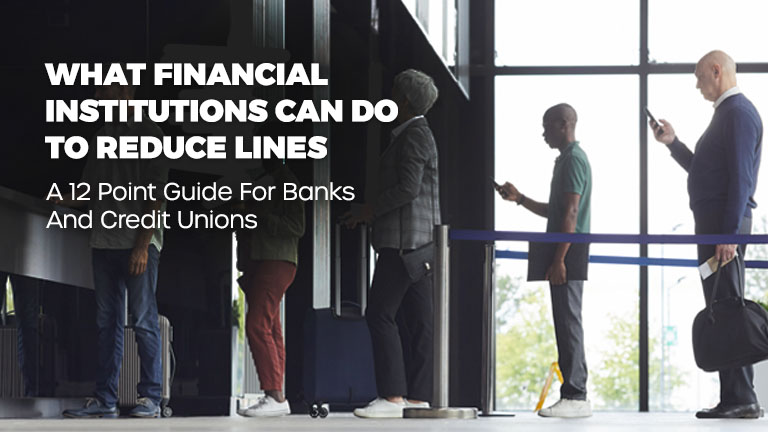
Lines are the most visible sign of a branch under strain. A customer who walks in, sees a long queue, and walks back out takes their transaction, their goodwill, and often their next product decision with them. The data backs up the instinct: 74 percent of people say they will abandon a physical line before it is their turn, and 70 percent would rather wait in a virtual line if given the choice (Source: Waitwhile Consumer Survey, 2023).
Branches still matter. In the fourth quarter of 2024, 45 percent of U.S. bank account holders conducted activity in person at a branch (Source: FDIC). The question is no longer whether customers visit, but whether the visit is worth their time once they arrive. A long line does more than test patience. It pushes deposits, loan conversations, and relationships toward whichever institution makes the visit easier. As networks consolidate and each remaining branch carries more weight, reducing lines becomes a direct lever on customer satisfaction, staff productivity, and the revenue each location can generate.
This guide sets out twelve practical techniques for senior leaders, branch managers, and decision makers who want shorter lines and better service from the same staff and the same square footage. Where relevant, it shows how FMSI’s branch management platform supports each step.
1. Implement a queue management system
A queue management system replaces the physical line with a managed digital flow. In a bank queue management system, customers enter through a kiosk, tablet, or mobile device, and the system places them in a virtual line and routes them by rules rather than who happened to stand where. This single change removes the visual deterrent of a long line and gives managers a live picture of who is waiting and why. It also reduces waiting times by allowing customers to receive real-time updates on their place in line, which lowers frustration and supports quicker service and faster service.
FMSI Lobby is built for this as a smart queue management system in a banking context, giving branches a more organized bank queuing system for lobby traffic. It tracks lobby activity in real time, matches each customer with the right staff member, and reduces both walkouts and wait times. The branch stops running on memory and guesswork and starts running on a shared, accurate view of the floor. It also creates a record of every visit, so leaders can see not only today’s line but the recurring patterns that produce it.
2. Use virtual queuing from mobile devices
A virtual queue lets customers join the line before they reach the counter, or even before they reach the branch, with mobile integration making it easy to enter the line through a mobile app. They hold their place from a phone or other online platforms, then wait wherever they choose: in the lobby, in the car, or somewhere more useful than a roped-off aisle. This supports customer experience by letting people queue remotely through multiple channels. Given that 70 percent of people prefer a virtual line to a physical one (Source: Waitwhile, 2023), this is one of the fastest ways to shrink the line that customers actually see.
FMSI Lobby supports remote check-in so the waiting experience starts on the customer’s terms. The physical lobby empties, perceived wait time drops, and the customer arrives at the desk ready to be served. The line that forms inside the branch is only the part customers can see, and a virtual queue moves much of that wait off the floor entirely.
3. Combine appointments with walk-in management
Scheduled visits and walk in customers should live in one system, not two. When they are managed separately, staff juggle parallel queues and customers fall through the gaps. A combined flow treats a 10:15 appointment and a 10:05 walk-in with the same routing logic, so neither is left waiting because the other was invisible.
FMSI Appointments lets customers book online, by phone, or in branch, and works alongside FMSI Lobby so appointments and walk ins move through a single, coordinated flow while reducing in-branch waiting. The result is a hybrid service model that protects appointment times without turning walk-ins away. Lower wait times for both pre-booked and walk-in visitors improve satisfaction and support customer loyalty. For higher-value conversations such as lending or account opening, a booked time removes the line altogether, while routine walk-ins still flow through the same board.
4. Deploy self-service kiosks for routine transactions
Many branch visits are short and simple: a balance check, a deposit, a card reissue. Routing these to self-service kiosks keeps routine tasks out of the main line entirely, so trained staff can focus on higher-value customer interaction. The line shortens not because the branch is busier, but because the right work reaches the right place.
Kiosk check-in also feeds the queue system, so even self-directed customers stay visible to managers. That supports the entire branch experience by reducing congestion and moving simple requests out of the main line. FMSI Lobby uses that check-in data to keep the floor picture complete, so no one is served twice and no one is forgotten. Self-service suits the customer who would rather not wait for a task they can finish in under a minute, and it keeps the simplest transactions moving during the busiest part of the day.
5. Show queue status on dashboards and signage
People wait more patiently when they know how long the wait will be. Real-time dashboards give staff an accurate view of queue length and service times, while digital signage and digital displays tell customers where they stand. Clear delay information is one of the most reliable ways to improve how a wait feels, even when the wait itself is unchanged.
FMSI Lobby and FMSI Analytics turn floor activity into live, readable information for both sides of the counter. Managers see pressure building before it becomes a backlog. Customers see honest estimates instead of an unmoving line. That visibility also supports real time monitoring for managers and customers. Perceived wait time, not just the time on the clock, drives how customers rate the visit, and visibility is the least expensive way to improve it.
6. Use analytics to match staffing to demand
Lines often form not because a branch is understaffed overall, but because staffing does not match the pattern of demand across the day and week. Advanced analytics expose peak hours, average service times, and how customer flow, real time data, and service interactions shape staffing decisions, turning anecdote into a staffing plan. Banks can also see which transactions take longest and move some of that work to self-service.
FMSI Analytics captures branch performance data and identifies where time is lost, and FMSI Staff Scheduler turns those patterns into schedules that assign staff members based on customer demand, resource allocation, and staff availability. Aligning staff to demand is the single largest lever most branches have to pull, and it requires no new headcount. Real-time reporting also supports informed decisions and strategic decisions about staffing and process changes. A branch that opens with three tellers when its rush starts at midday will form a line every morning until the schedule reflects what the data already shows, improving operational efficiency; intelligent routing can cut processing time by 20–25% by directing customers to the right specialist based on customer needs.
7. Let customers interact with the queue before they arrive
The line gets shorter when part of the visit happens before the visit. Mobile and online pre-arrival tools across online platforms let customers book a time, state the reason for their visit, and join a queue remotely, so the branch can prepare rather than react.
FMSI Appointments enables this pre-arrival step. By the time the customer walks in, the branch already has the customer data captured before arrival and knows who they are and what they need. Preparation done in advance is service time saved at the counter, which means the next person in line is reached sooner. Capturing the reason for the visit ahead of time also routes the customer to the right person on the first try, avoiding the handoffs that quietly create a second line. Better pre-arrival routing supports more personalized service and helps staff serving customers faster on the first contact. Effective routing can also save 20–25% of processing time by matching each visit to the most appropriate staff based on need and availability.
8. Train staff to handle specialized work and balance loads
Technology shortens lines only if the people behind the counter can use the time it frees. Staff trained across specialized services can absorb demand that would otherwise bottleneck at a single desk, especially during busy periods, and managers who can see workload in real time can rebalance before a queue forms.
FMSI Analytics shows where service times run long and where capacity sits idle, giving managers the evidence to cross-train deliberately and distribute work evenly. That kind of load balancing helps teams serve more customers without adding headcount. Balanced teams keep the line moving during the busiest periods, which is exactly when customers are least willing to wait. Cross-trained staff turn a single specialist into shared capacity, so one complex case no longer stalls everyone waiting behind it. Following proven implementation practices helps banks maximize value while minimizing disruption, and the combination of cross-training and manager oversight also supports better service for small business owners with more specialized needs.
9. Integrate the queue system with existing banking systems
A queue system that stands alone creates its own friction. Connected to core banking systems, core banking software, and customer databases, it can recognize customers at check-in, log outcomes automatically, and spare staff from re-keying what the institution already knows, with these links often relying on APIs between software solutions.
FMSI brings appointments, lobby management, analytics, and scheduling together in one platform, designed for banks and credit unions specifically. Integration removes the small delays that quietly lengthen every interaction, reducing operational inefficiencies and improving operational efficiency by keeping data flowing across connected systems. When the queue system and the core share data, a customer is identified once and served faster, rather than repeating information at every step.
10. Personalize service using check-in data
Information gathered at check-in does more than order the queue. It helps staff deliver more personalized service, improve the overall customer journey, greet customers by name, see the reason for the visit, and start the conversation prepared rather than cold. A prepared interaction is a shorter interaction, and a shorter interaction moves the line.
FMSI Lobby and FMSI Appointments carry check-in details to the staff member before the customer reaches the desk. The customer feels recognized, which strengthens the customer experience and matters for banking institutions trying to differentiate service in branch, the employee feels equipped, and the branch serves more people well in the same hours. Personalization is not only a courtesy. It shortens the visit because the employee is not starting from a blank page.
11. Keep customers updated across signage, SMS, email, and app
A customer who has been told accurately that they will be seen in eight minutes tolerates the wait far better than one staring at a line that never moves. Updates across digital signage, SMS, email, app notifications, and messaging platforms manage expectations and let people step away without losing their place. A qr code can also support quick check-in or reclaiming a place in line from a mobile device.
FMSI Lobby keeps customers informed of their position and progress through the channels they already use, and updates across these channels mean the system helps customers stay informed without crowding the branch. Notifications also recover would-be walkouts: a customer who steps out can be called back when their turn arrives, instead of being lost to a competitor. The goal is to replace uncertainty with an accurate expectation, because uncertainty is what turns a tolerable wait into a walkout.
12. Establish ongoing support and continuous evaluation
Reducing lines is not a one-time project. Demand shifts, products change, and a system that fit last year drifts out of step with this year, so implementation and optimization require several key considerations beyond the initial rollout, including needs assessment, technology selection, customization, integration with existing systems, staff training, pilot testing, customer communication, data analysis, and ongoing support. Continuous evaluation, supported by regular measurement, keeps the branch ahead of those changes rather than reacting to them.
FMSI Analytics provides the ongoing visibility to spot inefficiencies as they emerge, and FMSI works with institutions as a long-term branch operations partner rather than a one-off vendor. For banks today, that means using a repeatable review process that supports ongoing tuning, staff training, and data analysis over time. The branches that keep lines short are the ones that keep measuring, adjusting, and refining what they have. A regular review of wait times, service mix, and staffing against the data keeps small inefficiencies from hardening into permanent lines.
Conclusion
Shorter lines are the visible result of a branch that is well organized beneath the surface. Taken together, these twelve techniques attack the problem from every angle: a queue management system and virtual queuing remove the physical line, combined appointments and self-service route work to the right place, dashboards and notifications make the remaining wait feel fair, and analytics and scheduling make sure the right people are on the floor at the right time.
None of these techniques requires the branch to be larger, busier, or more heavily staffed. They require the work to be organized and the wait to be visible, which is what turns the same floor space and the same team into a faster, calmer experience.
The payoff is measurable. Customers who would have abandoned the line stay and are served. Staff spend their time on work that matters instead of managing a crowd. And each branch, carrying more weight as networks consolidate, earns more of the loyalty and revenue it is capable of.
FMSI brings appointments, lobby management, analytics, and workforce optimization together in one platform built for banks and credit unions, with more than two decades of focus on branch operations. For institutions ready to turn long lines into a competitive advantage, that focus is where the work begins.
Sources
• FDIC, 2024 National Survey of Unbanked and Underbanked Households (in-person branch use): https://www.fdic.gov
• Waitwhile, Consumer Survey: The State of Waiting in Line (2023), 1,202 U.S. adults: https://waitwhile.com/blog/consumer-survey-waiting-in-line-2023/
• BAI, Three steps for managing customer wait times: https://www.bai.org/banking-strategies/three-steps-for-managing-customer-wait-times/