

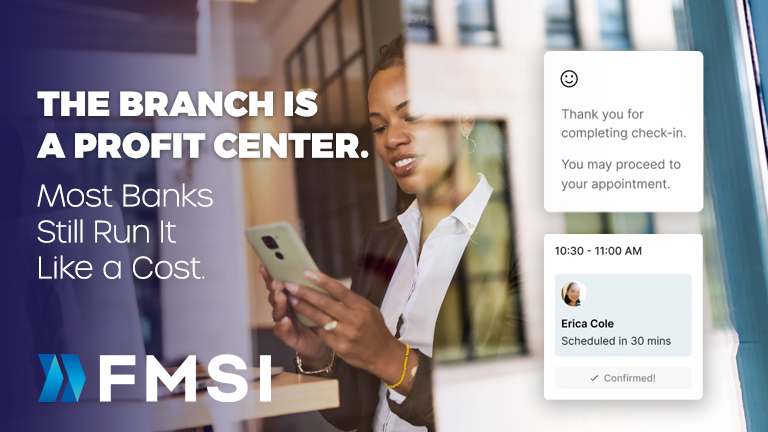
Ask most boards how they see the branch network and the answer comes back in the language of overhead. Square footage, lease terms, headcount, utilities. The reflex that follows is predictable: when margins tighten, close locations. It is a tidy way to manage a line item. It is a poor way to manage an asset that, run well, generates revenue no digital channel can match.
The numbers behind the cost reflex are real. U.S. bank branches peaked at nearly 83,000 in 2012 and fell below 65,000 by the second quarter of 2025, a net loss of roughly 18,000 locations in 13 years. But the headline hides a split in strategy. JPMorgan Chase added more than 100 net branches in 2025 while most competitors contracted. Among credit unions, 66% plan to open new branches and 55% plan to repurpose existing ones (FMSI State of the Industry 2026). The strongest institutions are not retreating from the branch. They are rebuilding what it does.
What the cost framing misses
Treating the branch as pure overhead assumes the traffic walking through the door is interchangeable and declining. The first part was never true, and the second part misreads the shift. Today 78% of members prefer digital as their primary channel, rising to 80% among Gen Z and millennials (FMSI State of the Industry 2026). That does not empty the branch. It changes the visit.
When digital absorbs routine transactions, what remains in the branch is the complex, high-value work: lending conversations, account opening, advice tied to a life event. Strikingly, 71% of leaders say they would keep a branch open even with zero transactions, because the value is in the conversation, not the transaction count. A network measured only on cost per location will never see that value. It only sees the rent.
Run it like a P&L and you measure it like one
Closing branches saves money. Redesigning them creates value. The institutions acting on that distinction are investing in smaller, smarter locations and, more importantly, in the data a profit center is expected to have: traffic patterns by day and hour, appointment conversion rates, staffing utilization, and branch-level performance benchmarked across the network.
That is the gap between a cost center and a profit center. A cost center reports what it spent. A profit center reports what it returned and proves it. Without branch performance analytics, every branch investment is a matter of faith, and faith is the first thing a board cuts. With it, the branch earns a seat in the revenue conversation.
Why this matters more in a consolidation year
The sector is consolidating from a position of strength, not distress. Credit unions closed 2025 with $2.4 trillion in total assets and net income up 31.5% year over year, yet the number of federally insured credit unions fell to 4,287 as healthy institutions chose to combine. More than 200 credit union mergers are projected in 2026 if current momentum holds (FMSI State of the Industry 2026).
In that environment, operational efficiency is not a back-office concern. It is the difference between sides of a deal. Institutions that run data-driven staffing, branch performance analytics, and consistent member experiences are positioned as acquirers rather than acquisition targets. A branch network that can prove its contribution is an asset on the balance sheet. One that only shows up as cost is a candidate for someone else’s synergy math.
The takeaway
The branch is not a relic to be managed down. It is the highest-value face-to-face channel a community institution owns, and in 2026 it is where complex revenue is won. The question for the executive team is not how few branches you can operate. It is whether you can measure what each one returns. Run the branch like a profit center, give it the data a profit center runs on, and the cost conversation changes into a growth one.
FMSI helps more than 140 financial institutions turn branch operations into measured performance through appointments, lobby management, analytics, and staff scheduling.
Sources
FMSI State of the Industry 2026 (Credit Unions & Community Banks)