

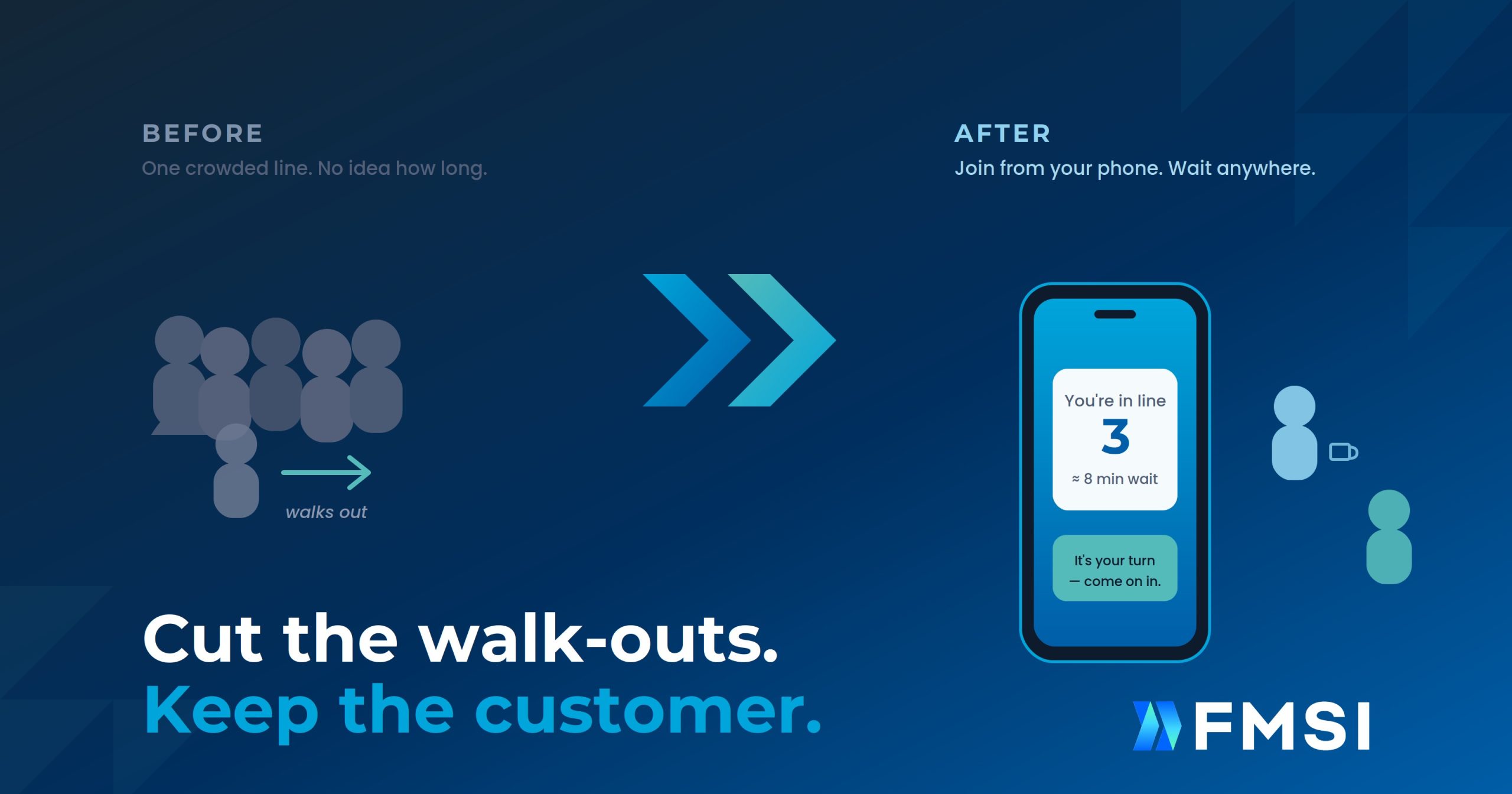
A customer walks into your branch to open a business account. Three people are ahead of them, nobody has said how long the wait will be, and a few minutes later they walk back out the door. Nearly half of retail bank customers will wait no longer than ten minutes before giving up, according to Verint’s research on branch wait times. That is the problem virtual queuing was built to solve. So what is virtual queuing, and why are community banks and credit unions leaning on it to reduce bank branch wait times? Here is the plain-English version.
What is virtual queuing?
Virtual queuing replaces the physical line with a digital one. Instead of standing shoulder to shoulder and guessing how much longer they will be stuck there, a customer joins the queue from their phone, a lobby kiosk, or a greeter’s tablet. Then they wait wherever they like, whether that is a chair in the lobby, their car, or the coffee shop next door, until a text message tells them it is their turn.
The branch still serves people in the order they arrive. What changes is that the line turns into information instead of a crowd. Staff can see who is waiting, what each person came in for, and how long they have been there. Customers see a realistic wait estimate and get updates as the queue moves. Nobody loses their place, and nobody has to hover near the door to protect it.
That distinction matters more in banking than in most industries, because a branch visit is rarely casual.
Walk-outs cost more than a single transaction
People do not drive to a branch to check a balance anymore. They do that on their phone. When someone shows up in person, they usually have a reason that carries weight: a mortgage question, a business account, a dispute, a decision they want to talk through with a human being.
That is exactly the kind of moment branches are built for. The American Bankers Association’s 2025 national survey found that while most routine banking has moved to mobile, the branch remains the channel consumers turn to for complex, face-to-face transactions. Accenture’s 2025 banking consumer study goes further, reporting that customers across every generation still value neighborhood branches for specific, important interactions, and that banks willing to deepen those personal relationships could lift revenue from primary customers by as much as 20%.
So a walk-out is not a missed teller transaction. It is often a mortgage that closes somewhere else, a business relationship that never starts, or a member who quietly decides your branch is not worth the trip. Each one leaves without a word, which means it also never shows up as a complaint you can act on. The damage is invisible until you look at the numbers.
How virtual queuing works inside a branch
The mechanics are straightforward, and a good lobby management system handles them without adding steps for your staff.
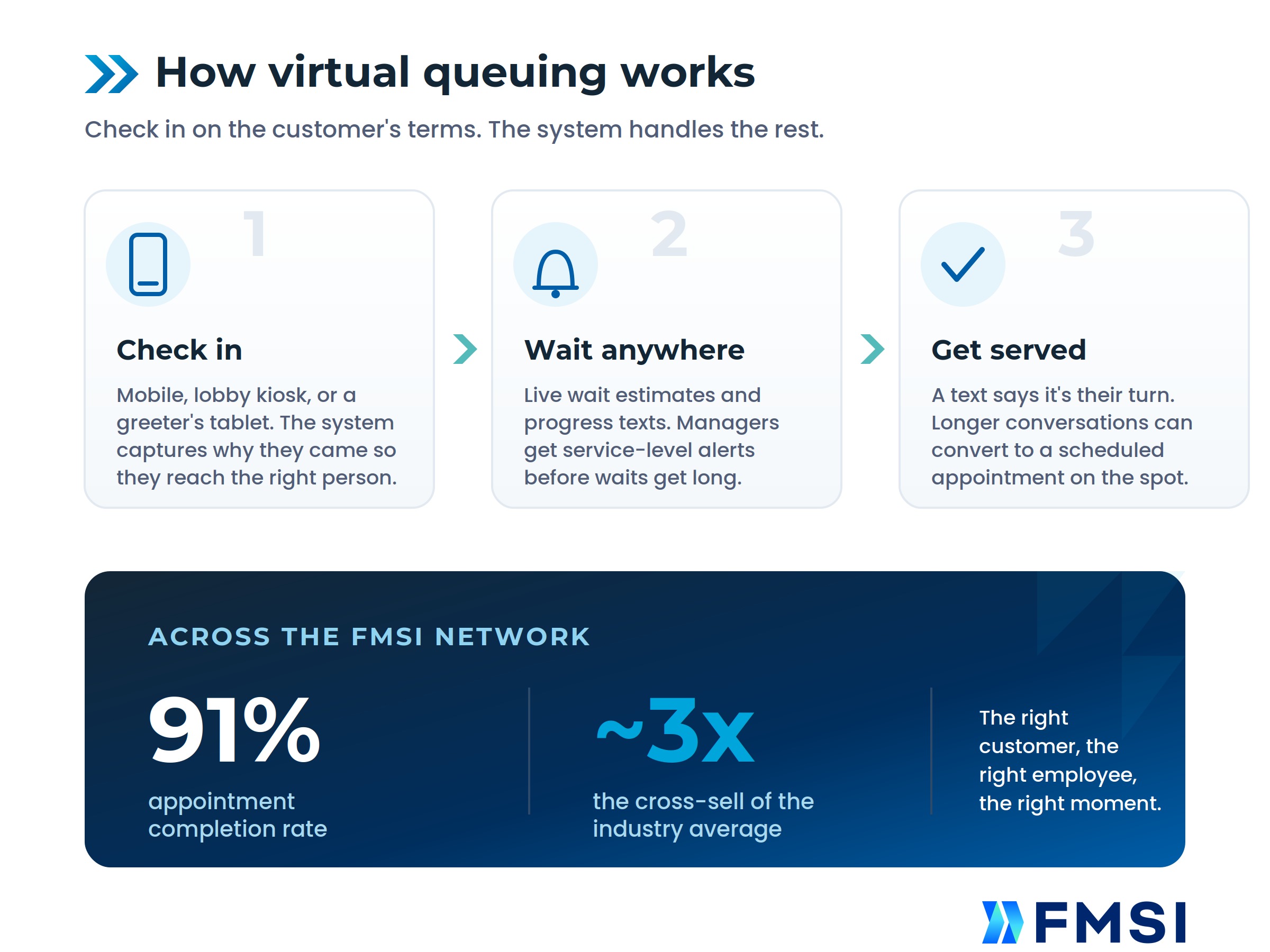
Check-in happens on the customer’s terms. They can sign in remotely from a mobile device before they arrive, scan a code or use a self-service kiosk in the lobby, or get checked in by a greeter with a tablet. However they enter the queue, the system captures why they are there so the branch can route them to the right person rather than the next open seat.
From that point, three things run in the background. The customer receives live wait-time estimates and progress updates, which is the single most effective way to keep someone from bailing. Managers get real-time visibility into the queue and service-level alerts when a wait starts creeping toward the danger zone, so they can pull a staff member off the back office or open a second window before anyone gets frustrated. And when a walk-in turns out to need a longer conversation, the system can convert them into a scheduled appointment instead of making them wait or come back.
The queue stops being a number-taker and becomes a tool your team can actually manage.
What changes when the line goes virtual
The first thing that changes is the wait itself. Some of the reduction is real, because better routing and staffing alerts move people through faster. Some of it is perception, because a customer who can see their place in line and step away feels the wait far less than one trapped in a slow-moving row of strangers. Both effects push people past the point where they would otherwise walk out.
The second thing that changes is your visibility. Every check-in, wait time, and hand-off becomes data. You can see which branches run hot at lunch, which services trigger the longest waits, and where customers are slipping away. That turns branch staffing from a guessing game into a demand-matching exercise, and it gives you a defensible answer when someone asks why a location needs another full-time employee, or does not.
The results show up in the numbers that leadership cares about. Across the FMSI network, banks and credit unions run at a 91% appointment completion rate and roughly three times the cross-sell of the industry average, because the right customer reaches the right, prepared employee at the right moment. Fewer walk-outs feed directly into more completed conversations, and more completed conversations feed into growth.
What to look for in a banking-grade system
Not every queue tool is built for a regulated financial institution, so a few requirements separate the serious options from the rest.
It should handle walk-ins and appointments in one unified view, because your lobby is a mix of both and your staff should not be juggling two systems. It should surface customer context at check-in, so the person behind the desk knows the account tier, the reason for the visit, and any recent history before the conversation starts. And it should keep a clean, exportable record of every interaction, because in banking, timestamps and accountability are not optional.
Get those three right and the queue becomes what it should be: a quiet, dependable engine that turns foot traffic into finished business.
See it in your own branches
Virtual queuing is not a novelty feature. It is a practical fix for a measurable problem, and the institutions using it are keeping customers who used to walk out the door. If you want to see how it would work across your branch network, request a demo and we will walk through it against your real lobby traffic.