

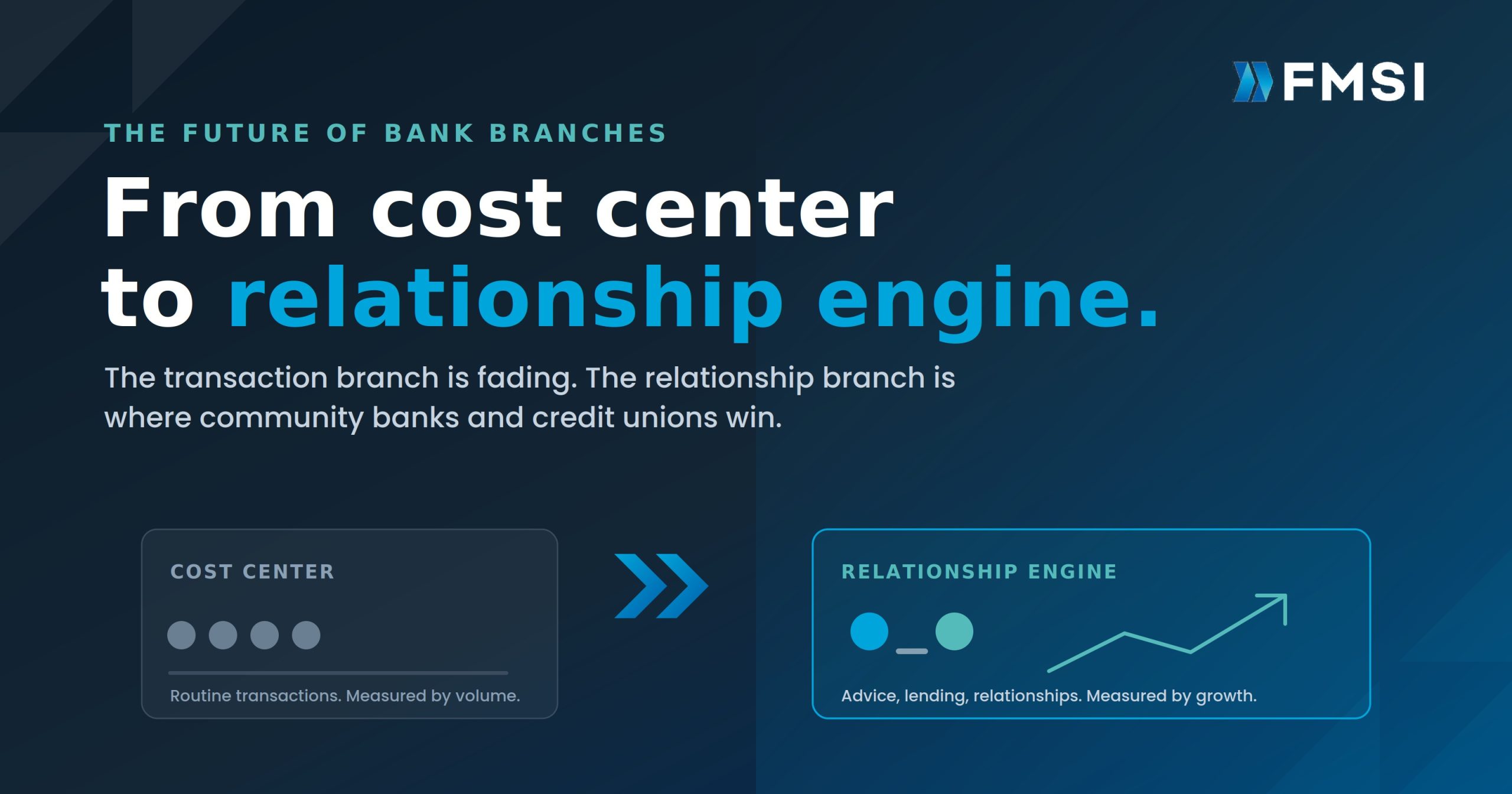
From Cost Center to Relationship Engine
For twenty years, the story about the future of bank branches has been a countdown to zero. Digital would win, foot traffic would vanish, and the branch would follow the video store into history. Half of that story is true. The other half is where community banks and credit unions are about to win.
Here is what actually happened. Routine transactions left the branch and never came back. Teller transaction volumes are down 32% compared with 2019 and have stabilized there, according to Curinos – a drop equal to more than one full teller’s workload per branch. The American Bankers Association’s 2024 consumer survey found that 55% of customers now manage their accounts mostly through a mobile app and just 8% do so mainly by visiting a branch. Deposits, transfers, and balance checks moved to the phone, and no branch strategy is going to pull them back.
So the transaction branch is dying. That is not the same as the branch dying. And confusing the two is the most expensive mistake a retail banking leader can make right now.
The branch didn’t lose its value. It changed its job.
Strip out the routine transactions and look at what people still walk into a branch to do. They open accounts. They apply for loans. They sort out the problem the chatbot couldn’t. They ask whether they can afford the house, the truck, the expansion. Accenture’s global banking study found that more than six in ten customers still turn to branches to solve specific and complicated problems, and that two-thirds of consumers – across every age group – like having a branch nearby because it signals the institution is stable and available. The branch didn’t become worthless. It became the place where the hard, high-value, high-trust moments happen.
That shift changes the math on every square foot you operate. A branch measured by transaction count looks like a failing asset. The same branch measured by relationships opened, advice delivered, and products per household looks like the most valuable real estate you own. Nothing about the building changed. What changed is the question you ask of it.
There is real money in asking the right question. Accenture estimates that banks building deeper personal relationships could lift revenue from their primary customers by up to 20%. J.D. Power’s 2024 advice study puts a finer point on it: only 42% of customers recall their bank ever giving them guidance, but when a customer acts on specific advice, satisfaction jumps 163 points on a 1,000-point scale. The advice gap is enormous, and closing it is the single clearest path to both loyalty and growth. Most of that advice has to be delivered by a person, in a room, with the customer’s full attention. That room is your branch.
Why this is a community bank and credit union advantage
Megabanks and neobanks are structurally built to win the transaction. They have the app budgets and the 1-800 numbers. Fine. Let them have the balance checks. The moment that matters – the advice conversation, the local judgment call on a loan, the relationship that spans a family or a business for twenty years – is the moment community institutions were built for and the big players cannot easily copy.
The reason is something bank researchers call soft information: the loan officer who knows the borrower, understands the business plan, and can make a flexible call that no national underwriting model would make. It is why credit unions have added more than 24 million members since 2019 even as the number of institutions shrank. Relationship banking is not a slogan for community FIs. It is the actual product, and the branch is where it gets delivered.
The branch closure numbers back this up in a way most people miss. Yes, the national branch network has contracted – the National Community Reinvestment Coalition has tracked years of decline driven mostly by big-bank mergers and consolidation. But the pace has slowed sharply, and the closures have been concentrated among the largest banks. In 2024, the biggest banks shed hundreds of branches while more than 900 new branches opened, many by community institutions expanding into markets the giants abandoned. When a megabank closes the only branch in a small-business corridor, the relationship that branch held doesn’t disappear. It goes looking for a new home. Community banks and credit unions are that home.
The economics make the decision for you
Migrating transactions out of the branch isn’t just customer preference – it’s a cost mandate. McKinsey found that a deposit handled digitally costs roughly $0.03 versus $0.65 at the teller line, a 95% reduction. Every routine transaction you move to self-service frees capacity you can redeploy toward advice. Handled well, that reallocation converts a fixed cost into a revenue engine. Handled poorly – by cutting staff without repurposing the branch – it just makes a shrinking asset shrink faster.
That is the fork in the road. Cut, or convert. The institutions that treat branch transformation strategy as a cost-cutting exercise will end up with emptier, cheaper branches that do less. The ones that treat it as a redeployment – moving transactions to digital and moving people toward advice – will end up with branches that generate more relationship value per visit than they ever did as transaction counters.
What a relationship engine actually requires
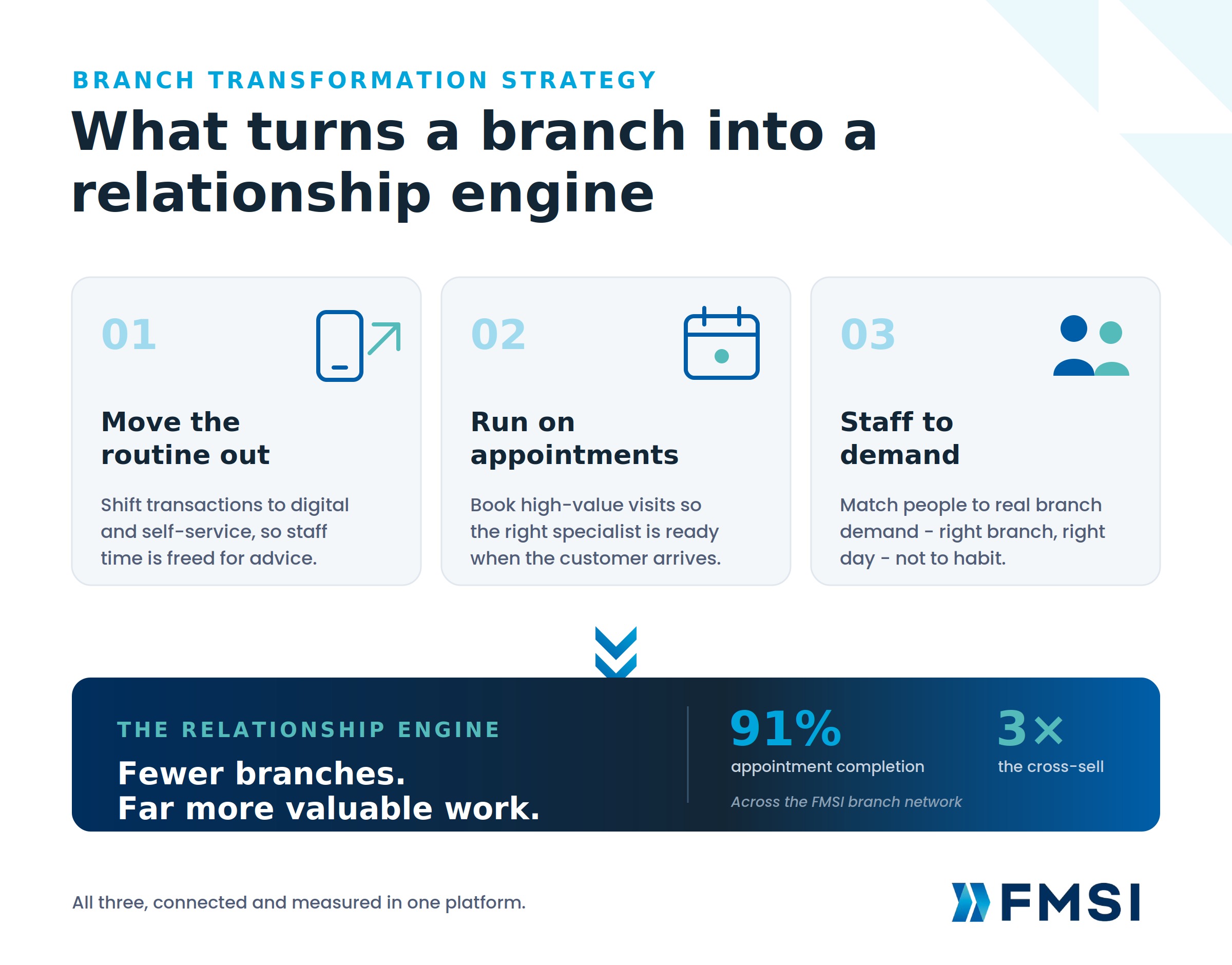
Turning a branch into a relationship engine is an operational project, not a poster in the break room. Three things have to be true.
First, routine work has to leave the lobby so your people have time to advise. That means real investment in self-service and digital so the teller line isn’t absorbing capacity that should be spent on the conversations that grow relationships.
Second, the branch has to run on appointments and readiness, not walk-in randomness. When a customer books time with a banker for a mortgage or a business account, you know who is coming, what they need, and who should meet them. Appointment-based scheduling turns an unpredictable lobby into a planned schedule of high-value conversations – and makes sure the right specialist is in the building when the customer arrives. This is the operating model most community FIs are still leaving on the table.
Third, you have to staff to demand, not to habit. Advice capacity is worthless if it’s sitting in the wrong branch on the wrong day. Aligning your people to actual branch demand – through workforce scheduling built on real traffic patterns – is what lets a leaner branch network deliver more advice, not less.
None of this works on instinct. You cannot manage a relationship engine with the tools built to count transactions. You need to see where demand actually is, which branches are converting visits into relationships, and where advice capacity is being wasted. That visibility – branch analytics that measure relationships and readiness rather than just transaction throughput – is the difference between a transformation strategy and a hope.
The branches are already telling you what they’ve become
The data point that should reframe the whole conversation is this: after the collapse in teller volume, a large share of branches now handle only a couple thousand transactions a month. Whether or not you have staffed them for it, those branches are already advice centers. The transactions left years ago. The only open question is whether you’ll equip them to do the job they’ve quietly shifted into, or keep measuring them against a job they no longer do.
The future of bank branches was never zero. It was fewer branches doing far more valuable work – the work that built community banking in the first place. The institutions that see the branch as a cost center will keep cutting until there’s nothing left to cut. The ones that see it as a relationship engine will build the advantage that neobanks can’t replicate and megabanks keep walking away from.
FMSI built RelationshipOS for exactly this shift – the platform that connects scheduling, lobby management, staffing, and analytics so a community bank or credit union can run its branches as relationship engines instead of transaction counters. Banks and credit unions on FMSI run with 91% appointment completion and three times the cross-sell of the industry average.