

What Changed for Community Banks and Credit Unions This Month
A roundup of the news worth your attention from NCUA, America’s Credit Unions, and ICBA, mid-June through mid-July 2026.
The last month handed community financial institutions something rare: a run of regulatory news that mostly breaks in your favor. A bipartisan housing law delivered real exam relief. Two NCUA rules took effect that lighten what your compliance team carries. And the rules for sharing fraud intelligence between institutions got sharper. Here is what moved, and what it means for the people running your branches.
The numbers: earnings are up, but keep an eye on delinquency
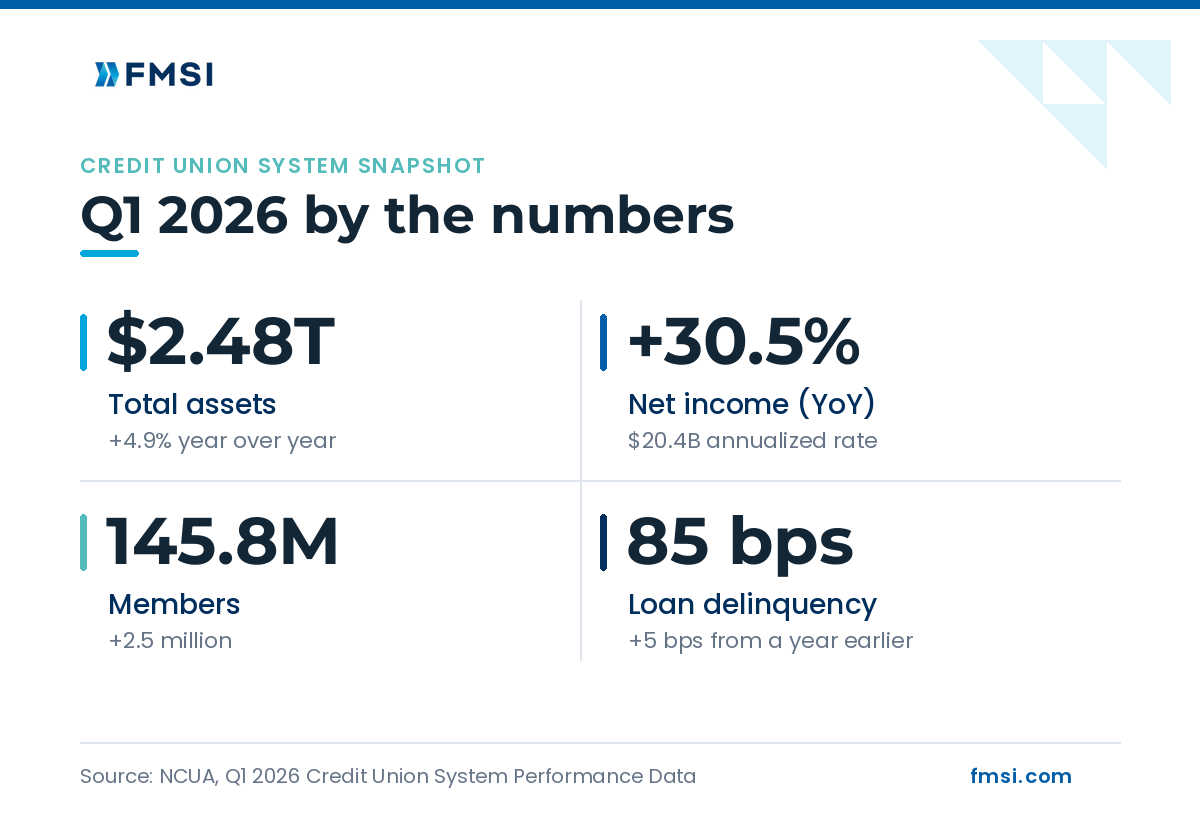
NCUA’s most recent system-wide data shows credit unions in solid shape heading into the second half of the year. Total assets reached $2.48 trillion, up 4.9 percent year over year. Membership grew by 2.5 million to 145.8 million. Net income ran at a $20.4 billion annualized rate, up 30.5 percent from the same point in 2025.
Two signals deserve a closer look. Delinquency rose to 85 basis points, up 5 basis points from a year earlier, and the number of federally insured credit unions fell to 4,250 from 4,411. Earnings are strong, consolidation continues, and credit quality is softening at the edges. For a branch leader, that is a reminder to watch your own delinquency trend against the system and to make sure your frontline conversations are catching stress early.
A housing law that quietly rewrote the rules for smaller institutions
The headline event was the enactment of the 21st Century ROAD to Housing Act on July 11. It became law without the president’s signature, and most of the coverage focused on housing supply. Buried inside it were the provisions community banks and credit unions have been asking for.
For banks up to $6 billion in assets, the law establishes an 18-month examination cycle instead of the shorter one many have lived under. It lets institutions hold more custodial and reciprocal deposits without triggering brokered-deposit treatment, streamlines the path to forming a new bank, and creates a two-year rural de novo pilot. ICBA, which pushed hard for the package, called it a win for community banking.
Credit unions got their own piece. The law folds in the Credit Union Board Modernization Act, which lets a well-run federal credit union board meet six times a year rather than twelve, provided it meets at least once a quarter. Newer credit unions and any carrying a composite or management CAMELS rating of 3, 4, or 5 still meet monthly. America’s Credit Unions framed the change as overdue relief from a meeting schedule written for a different era.
If your board qualifies, this is worth a conversation at your next meeting. Fewer required board meetings frees up leadership time without touching the oversight that keeps regulators comfortable.
Two NCUA rules took effect that lower your operating load
While the housing bill moved through Congress, NCUA finalized two rules that reached their effective dates inside this window.
The first protects a revenue line you probably do not think about until it is threatened. Effective June 30, NCUA confirmed that federal credit unions’ authority to charge non-interest fees includes interchange, and that state laws attempting to cap or ban interchange – the Illinois Interchange Fee Prohibition Act being the one everyone watches – are preempted for federal credit unions. The OCC put the same protection in place for national banks the same day. For any institution that issues cards, this heads off a patchwork of conflicting state rules and keeps a meaningful piece of non-interest income intact.
The second is pure operational relief. Effective July 16, NCUA modernized its vital-records preservation rule, which had gone largely untouched since 1972. Credit unions now get more say over what goes in their vital-records log, and the rule clarifies that decades of historical member statements do not have to be kept forever. That means lower storage cost and less uncertainty about what you are required to hold. Review your retention policy and you may find room to simplify.
Fraud sharing gets a real upgrade
NCUA drew attention to FinCEN’s revised guidance for the 314(b) program, which gives participating institutions legal cover to share information about fraud, money laundering, and other illicit activity with one another in real time. The revised guidance adds concrete examples of what you can share, including video surveillance footage, IP addresses and other cyber data, and specific fraud indicators. Participation stays voluntary.
For institutions fighting check fraud and account takeover at the teller line, this is a practical tool. If you are not enrolled in 314(b), it is worth putting on the agenda. The fraud your branch sees this week is often the same fraud hitting the institution across town.
The fights still in play
A few debates ran hot this month without resolving, and each one could reshape how you compete.
The stablecoin question drew an unusual coalition. ICBA, the ABA, and 76 state associations wrote to Senate leadership urging tighter yield rules in the CLARITY Act, warning that crypto platforms could otherwise structure incentives that turn payment stablecoins into deposit substitutes. ICBA’s own analysis put the stakes at a potential $1.3 trillion drop in industry deposits. Whether that figure holds is contested, but the concern – that deposits could migrate out of community institutions – is one every deposit-funded lender should track.
The long-running dispute over the credit union tax exemption flared again. ICBA renewed its call to end the exemption for credit unions above $1 billion in assets, pointing to the pace of credit unions acquiring community banks. America’s Credit Unions rejected both the framing and the data, defending the exemption as central to the member-owned model. FMSI works with institutions on both sides of this line, and both make their case in good faith. The practical takeaway is that the debate is live in Washington and will not settle quietly.
On the regulatory front, America’s Credit Unions backed a draft CFPB Reform Act that would bring the bureau under the appropriations process and raise the supervision threshold for “very large” institutions to $21 billion from $10 billion. The Senate Banking Committee also moved on the nomination of John Crews to the NCUA board, a seat that could shift the board’s composition and the tempo of the deregulation push already underway.
What to do with this
Three moves are worth making before the next month runs out. Confirm your card program is documented to rely on federal preemption against state interchange laws. Revisit your records-retention policy against the new NCUA rule and capture whatever savings are sitting there. And if your board qualifies for the new meeting cadence, or your institution qualifies for the 18-month exam cycle, put both on your next leadership agenda.
The regulatory wind is at your back right now. The institutions that move while it lasts will feel the difference.