

Walk into a community bank or credit union branch at 11 a.m. on a Tuesday and you tend to see the same picture. The teller line moves fast. A banker or two sit at desks. The lobby thins out before lunch. It looks efficient. It is also where most cross-sell quietly die.
The branch is still where relationships get built. McKinsey, drawing on Finalta data, found that branches accounted for 72 percent of newly acquired checking accounts in North America in 2023, and 92 percent of new-account balances. For midcap and community institutions the dependence runs higher. McKinsey’s midcap playbook puts branch-driven acquisition as high as 80 percent, against just 8 percent from digital channels. The people standing in that quiet lobby are your growth engine, not your overhead.
So why does so little deepening happen there? The answer is rarely the staff. It is what you have asked the staff to spend their day on.
The problem is capacity, not talent
Most branch teams are busy with the wrong things. Bancography’s analysis of transaction data from more than 1,000 U.S. branches, published through BAI, found an 18-point spread in teller workforce utilization between the best and worst performers. The strongest branches keep tellers on customer-facing work about 75 percent of the time. The weakest sit at 64 percent, which means more than a third of paid teller time goes to tasks no member ever sees.
That gap is the whole game. Every hour a banker spends fighting an unbalanced schedule, covering an unexpected rush, or standing idle through a dead afternoon is an hour not spent in a conversation that opens an account. You cannot coach your way out of a capacity problem. You have to schedule your way out of it.
This is where branch workforce optimization stops being an operational fantasy and starts being a revenue lever. When you forecast traffic by hour and match staffing to real demand, you free up the exact people you need for needs-based conversations at the exact moments members are in front of them. Right person, right desk, right time. The schedule becomes a sales strategy.
Better conversations open more accounts
Prepared staff have better conversations, and better conversations move products. The evidence here is not subtle.
J.D. Power’s 2023 U.S. Retail Banking Satisfaction Study found that 47 percent of customers who received effective advice from their bank went on to open a new account. The catch: only 21 percent said they received any advice at all in the prior year. A companion advice study that year put the gap even wider, with 62 percent of customers unable to recall a single piece of guidance from their bank over twelve months. Demand for advice is climbing, too. By 2025, J.D. Power reported that 43 percent of customers now count as financially vulnerable, up from 27 percent five years earlier, with the strongest appetite among customers under 40.
Read those numbers together and the opportunity is obvious. Roughly half of members who get real guidance say yes to something new, and most members never get the guidance. The product isn’t the bottleneck. The conversation is.
The payoff compounds over time. Gallup’s research on retail banking engagement found that fully engaged customers deliver a 23 percent premium in share of wallet, profitability, and revenue over the average customer. Peer-reviewed work in the Review of Financial Studies backs the mechanism from the other direction: a bank is about 20 percentage points more likely to sell a loan to an existing depositor than to a comparable outside household. Relationships you already have are the cheapest growth you will ever find. You just have to be staffed to nurture them.
What “prepared” actually looks like
Preparation is not a pep talk. It is a set of operational conditions you can plan for.
Know who is walking in before they arrive. When a member books ahead through appointment scheduling, the banker sees the reason for the visit and can pull the relationship, spot the gap, and plan the ask. A mortgage question becomes a conversation about a checking relationship and autopay. Intent captured in advance is intent you can act on.
Route people to the right banker, not the next open chair. Lobby management that matches a member to the staff member best suited to their need turns a transaction into a relationship touch. The member with a business deposit reaches someone who can talk treasury services, instead of a teller who can only take the check.
Protect banker time for the work that pays. This is the scheduling discipline again. If your universal bankers are constantly pulled to the teller line during rushes, they never build the rhythm that good discovery requires. Coverage aligned to demand is what makes the other two moves possible.
None of this asks your team to sell harder. It asks your operation to put ready people in front of ready members. That is the difference between a branch that processes and a branch that grows.
Where the 3x comes from
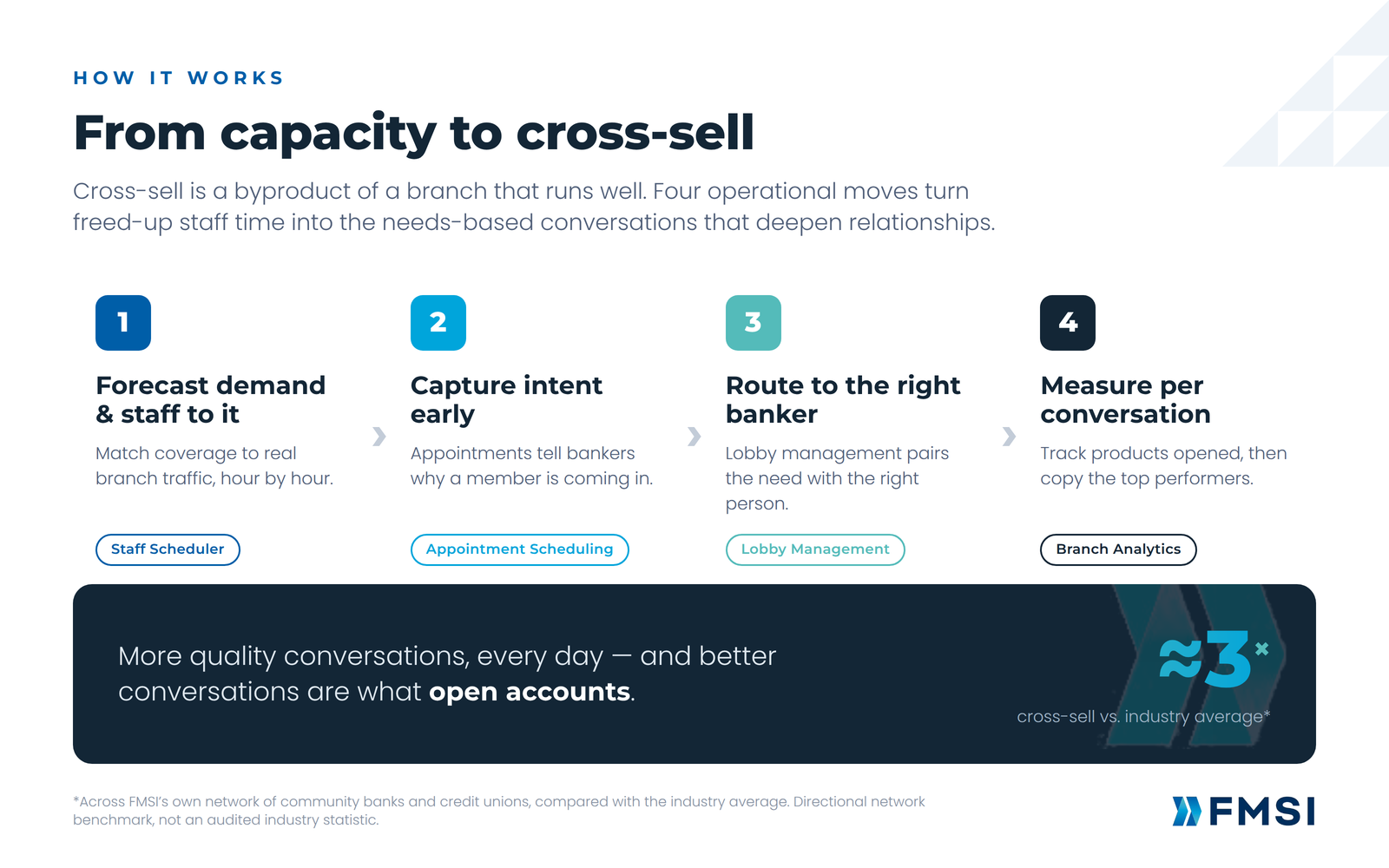
Across FMSI’s own network of community banks and credit unions, institutions running the full platform see roughly three times the cross-sell of the industry average. That figure is our network benchmark, not an audited industry statistic, so treat it as directional. What matters is why it holds up against the independent research above: when scheduling frees capacity, when appointments capture intent, and when the lobby routes members to the right banker, the number of quality conversations per day climbs, and quality conversations are what open accounts.
The only way to manage that is to measure it. Branch analytics lets you track products opened per conversation, conversion by branch, and the staffing patterns behind your best-performing locations, so you can move from anecdote to a repeatable playbook. If you cannot see which branches convert and why, you cannot scale what works. For a fuller view of what to watch, our guide to the metrics every branch ops leader should track is a good starting point.
Bank branch cross-sell strategies that hold up
The bank branch cross-sell strategies that survive contact with a real lobby share one trait. They fix the operation before they touch the pitch. In order:
- Forecast demand and staff to it. Reclaim the third of teller time the weakest branches waste, and redeploy it toward conversations.
- Capture intent early through appointments so bankers arrive prepared, not surprised.
- Match members to the right banker in the lobby, so the conversation fits the need.
- Measure products per conversation by branch, and copy your top performers.
Do those four things and cross-sell stops being a quarterly campaign you nag people about. It becomes a byproduct of a branch that runs well. The branch was always a profit center. Most institutions just staff it like a cost.