
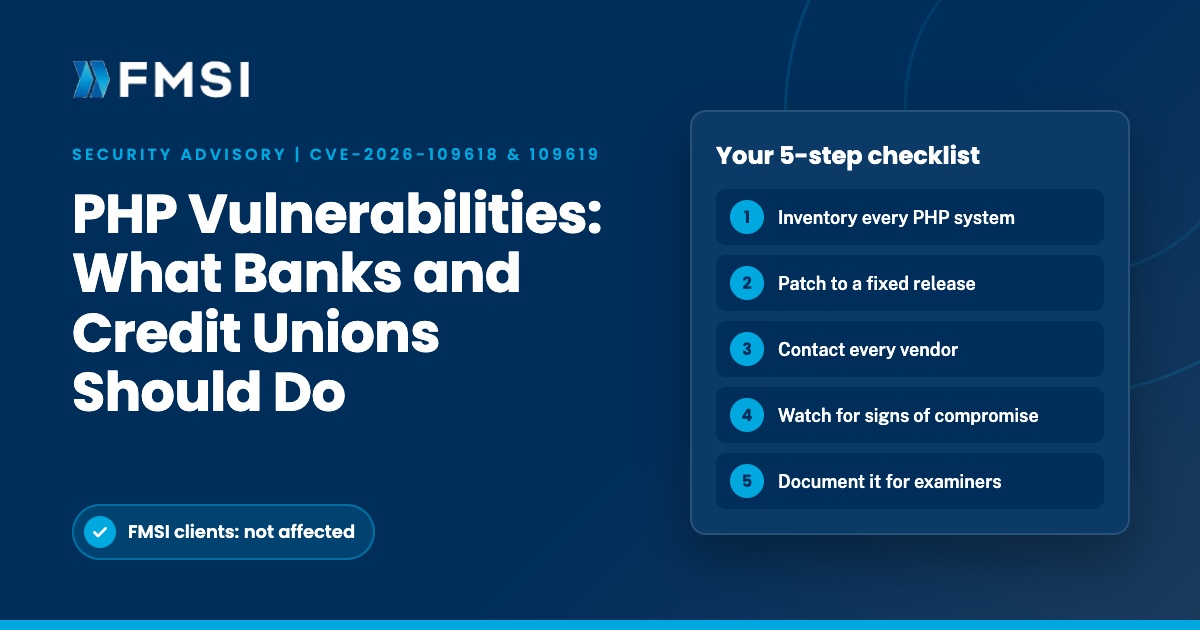
PHP Vulnerabilities: What Banks and Credit Unions Should Do

Key takeaways

  • What happened: two critical PHP flaws (CVSS 9.2) let attackers run code on unpatched servers without logging in.
  • Who's at risk: any institution running unpatched PHP on its website, forms or vendor-hosted tools.
  • FMSI clients: not affected. RelationshipOS does not use PHP, and no action is needed.

Two critical PHP flaws just hit. Is your institution exposed?

On October 21, 2026, the PHP project rushed out emergency fixes for two critical vulnerabilities, CVE-2026-109618 and CVE-2026-109619. Both carry a CVSS v4.0 score of 9.2. If your credit union or community bank runs PHP anywhere, from your public website to a vendor-hosted tool, an attacker could take control of that server without ever logging in.

Here’s the good news for FMSI clients: RelationshipOS does not use PHP, so it is not affected. No patches, no downtime, nothing to do.

But PHP is everywhere, and your exposure doesn’t stop at one vendor. Below is what happened, where PHP tends to hide inside a financial institution, a five-step checklist for your IT team, and the questions every vendor should be able to answer within days of a threat like this.

What happened with CVE-2026-109618 and CVE-2026-109619

PHP is a programming language behind a huge share of websites and web applications. The two flaws let an attacker run their own code on an unpatched PHP server, with no username or password required.

That’s why both are rated Critical (CVSS v4.0 9.2). Code execution on a web server can mean defaced websites, stolen form data, or a foothold into other systems.

Released

Oct 21, 2026

Severity

Critical
CVSS 9.2

Login needed

None

Fixed in

8.5.12 · 8.4.27
8.3.36 · 8.2.35

Older PHP branches get no official fix and need to move to a supported version.

Where PHP hides at credit unions and community banks

Most institutions don’t write PHP, but they often run it without knowing. The usual places to look:

Your public website

Especially if it's built on a common content management system or plugins.

Online forms and account tools

Loan applications, contact forms, rate calculators and appointment request pages.

Vendor-hosted applications

Tools your staff or members log into, where you can't see the code underneath.

Marketing and intranet sites

Built by an agency years ago and rarely updated.

The last two are the hardest. When a vendor hosts the software, you depend on them to know their own stack, patch fast and tell you about it. That makes this as much a third-party risk question as a technology one.

Your 5-step PHP vulnerability checklist

Share this with your IT and security teams today.

1

Inventory every system that runs PHP

Include internally hosted servers, your website, online account tools and anything an agency built for you.

2

Patch to a fixed release

Upgrade to PHP 8.5.12, 8.4.27, 8.3.36 or 8.2.35, or apply your vendor's updated packages. Anything on an older branch should move to a supported version.

3

Contact every technology vendor

Ask whether they're affected and when they'll patch (use the questions below).

4

Watch for signs of compromise

Review web server logs and unexpected file changes since mid-October on any PHP system that wasn't patched right away.

5

Document it for examiners

File vendor responses in your third-party risk records. Regulators will ask how you handled a critical, widely reported vulnerability.

Download the checklist (PDF)

5 questions to ask every technology vendor

A critical vulnerability is a stress test for your vendors. The good ones answer before you ask. If you’re still chasing replies a week later, that tells you something.

1. Does your product use PHP, or any component affected by these CVEs?

A good answer: a clear yes or no, not “we're looking into it.”

2. When did you notify clients?

A good answer: within days. Speed matters when a flaw needs no login to exploit.

3. If you're affected, when will you patch, and will there be downtime?

A good answer: a specific date and a downtime window, not a promise.

4. Can you give us a written advisory for our board and examiners?

A good answer: yes, ready to file in your vendor management records.

5. How will you tell us if anything changes?

A good answer: a named contact and a commitment to follow up.

Copy and send to your vendors

  1. Does your product use PHP, or any component affected by CVE-2026-109618 or CVE-2026-109619?
  2. When did you notify clients?
  3. If you're affected, when will you patch, and will there be downtime?
  4. Can you give us a written advisory for our board and examiners?
  5. How will you tell us if anything changes?

Vendors who can’t answer these quickly are adding risk to your institution, even if they turn out not to be affected.

Why FMSI clients didn’t lose a minute on this

While many institutions spent the week chasing vendors for answers, FMSI clients already had theirs.

Oct 21

PHP releases emergency fixes for two critical flaws

Oct 23

FMSI clients receive a written advisory

Today

Not affected. No patches, downtime or action needed

Not affected by design. RelationshipOS doesn’t use PHP, so the vulnerable component simply isn’t there to exploit. No emergency patch window, no downtime, no change to how your branches run.

Answered within two days. PHP released its fixes on October 21. FMSI clients had a written advisory on October 23, before most had time to ask.

Examiner-ready from day one. Our advisory is written to drop straight into your vendor management and third-party risk file, and it’s shareable with your board, auditors and regulators.

A team that keeps watching. We continue to monitor these vulnerabilities and will contact clients directly if anything changes.That’s the standard your branch technology partner should meet: secure architecture, fast and plain-language answers, and documentation you don’t have to request.

That’s the standard your branch technology partner should meet: secure architecture, fast and plain-language answers, and documentation you don’t have to request.

The takeaway: security is a vendor decision

While many institutions spent the week chasing vendors for answers, FMSI clients already had theirs.

FMSI security advisory: RelationshipOS not affected by PHP vulnerabilities

Already an FMSI client?

You're covered

Download the full security advisory for your vendor file, or email support@fmsi.com with any questions.

Download the advisory

Evaluating branch technology?

See RelationshipOS

Help your credit union or community bank build stronger member and customer relationships on a platform you never have to second-guess.

Request a demo

Request a Demo

Ready to turn your branch into a revenue engine? Let’s talk.